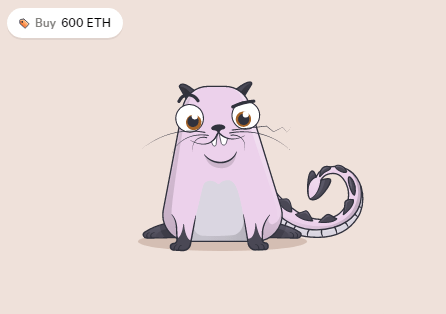
A quick search in Google for “NFT” produces a number of pictures of Bored Apes and this dashing digital feline who is also for sale for a mere 600 ETH. As I write this sentence, the price of Ethereum (ETH) is $2,781.22 USD per ETH, so the Non-Fungible-Token(NFT) screenshotted above, in this case a CryptoKittie named “Dragon” could be yours for a mere $1.67M.

Dragon is one of the older CryptoKitties, having been “hatched” in August 2018 (the game launched in 2017). This lovely, bug-eyed purplish dragon kitty can do all sorts of things in it’s blockchain based environment – most especially being bred to create more CryptoKitties. But perhaps it is not so much age as the catchy name of this virtual feline that commands such a price. After all, many of the newly hatched CryptoKitties only cost 0.02 ETH or ~$56. But those poor critters are currently sporting names like Gen 1 H1 Gene Swap. Nonetheless for nearly 5 years now people have been paying exorbitant amounts of money for these wee virtual beasties. Tamagotchi and Beanie Babies eat your heart out! These prices are several orders of magnitude higher and the manufacturing cost of these pets many orders of magnitude lower. But there’s a big difference – with a Beanie Baby or a Tamagotchi, you have to let the world know you have it yourself. CryptoKitties do their own signaling to the rest of the user base. Everyone in the game can look up who hatched Dragon and all sorts of other information about the precious rascal. So there’s the built in generator of envy and coveting that comes as a perk of possessing Dragon. And remember, each one is necessarily different so each and every single one of the billions that can be generated is absolutely unique and one of a kind.
Now a lot of people are excited to use NFTs to create virtual tokens (digital proxies) of original physical works of art and then use those NFTs to represent ownership. This is slightly more boring than the CryptoKitties, because presumably these new art-proxy-NFTs won’t do anything exciting like breed to make some sort of Rembrandt-Dali hybrid. However, there’s plenty of precedent outside the world of blockchains for these sorts of things. It is not unlike the concept of a title for an automobile or a deed to a house. So it’s not a particularly novel or new concept – just a new technology applied to problems society has tried to address before. It is very likely that blockchain based solutions for recording and transferring ownership of physical assets is the way of the future. Plenty of people would rejoice if the periodic chore of a trip to the Registry of Motor Vehicles or the Registry of Deeds was something that could be replaced with a few clicks on a phone based app. Alas, that future is not here just yet.
Generally speaking current NFTs have some major challenges:
- Technically difficult to actually mint and transact
- Rely in Proof-of-Work (PoW) chains – primarily ETH. ETH provides a level of security and validation that smaller chains can’t promise, but that comes at a high cost in terms of energy/environmental impact
- Many protocols will allow essentially any individual to mint a NFT. So that makes it possible for bad actors to mint and try to sell an NFT of someone else’s original physical creation. We saw something similar in 2017/2018 when hundreds of nearly identical clones of currencies were created and pumped then dumped.
These are all solvable problems. However, at the moment dozens (if not hundreds) of different protocols, exchanges and solutions are being launched in a “gold rush” style manner to address many different use-cases from music, to custom video game characters to digital versions of physical art. In time, I fully expect certain solutions/exchanges/protocols to be increasingly adopted which will create their own network effects, accelerating convergence to a handful of solutions capturing 80%+ of the transaction volume.
If you believe ETH will eventually become much more efficient by migrating to Proof-of-Stake(which I do), then it makes sense to select a solution that leverages the size of both that chain, its market cap and its developer community. However, in the intervening period it also makes sense to build a secondary ledger (sidechain) on top of ETH that can do things like batch creation and transfer of NFTs to more efficiently leverage the ETH chain and enormously reduce the energy requirements. Palm.io is essentially doing this and partnering with an auction house as Invaluable could help them (or another similar solution) accelerate adoption and convergence.
An example of how this might work:
- Whenever items are listed they are cataloged, verified and confirmed authentic in the systems via physical attestations from the auction houses, creators or similar traditional validation procedures.
- At the conclusion of each complete auction event, Invaluable uses the above records to create NFTs and ledger entries for all the items that transacted. This is initially done on a sidechain. Since the sidechain is private, protocol doesn’t really matter but for sake of discussion let’s say it is designed to be a clone of the planned ETH2 PoS protocols.
- The sidechain is then merged back into the PoW ETH chain. This offers several big positives:
- Since the same process will be done hundreds of thousands of times, substantial development effort can be invested in making sure it is accomplished via the most efficient set of commands possible – minimize the network effort (work in the energy hungry PoW chain) required to write it to the chain.
- Batching creation and transactions is inherently lower costs as it doesn’t rely on individual requests – like delivering a pallet or container of product vs an individual box.
- It can be timed to happen at times of relatively lower network congestion. Since the same transaction at different times can have a very different cost to process – immediacy often comes at a meaningful premium. These transactions are much less time sensitive then many others – EG the collector is likely delighted if they receive their NFT a couple days after the auction versus needing it to transact in minutes.
This is just one example of how such a mechanism might work in the short to medium term. In the long term, NFTs and the places they are created and exchanged will be narrowed to a few dominant players, by the process of Sexual Selection (not Natural Selection); the surviving NFTs and marketplaces that are most attractive will succcessfully transact with the most users and enhance their peacocking features attracting more users with whom to transact.
However, it is important to note that surviving is a pre-requirement of reproducing and expanding, and survival in this case is about consensus – particularly initial consensus of ownership. Once an NFT is credibly and widely determined to be legitimate, tracking the chain of ownership of that NFT is a pretty well-solved problem (for now at least). The initial sale is the rub – fraudulently selling title to an original work of art is a misstep that an exchange can make painfully few times and expect to continue to exist. Accordingly, the winners in this iterative, winner take most adventure will be the ones who figure out how to effectively capture not only the digital representation of the art they seek to sell, but also the digital analogs of the physical proof of ownership and the “signing authority” to make other believe in them. That is to say, a trusted authority must transition the physical art into the digital realm.
So at least in the near term the old adage “Buy Beware” remains true. It is a great idea to buy digital art, but make sure you know who you are buying it from and that they are credible enough for you to believe it is truly theirs to sell. Caveat Emptor.
Thank you for reading my thoughts. – Jay
For my dear readers who read this entire post, likely clicked a couple of the links and have found themselves here and wanting more , here are some links to articles and networks I found particularly helpful.
- https://www.ofnumbers.com/2021/02/14/bitcoin-and-other-pow-coins-are-an-esg-nightmare/
- https://github.com/memo/eco-nft
- https://www.artnome.com/greennfts
- https://www.theverge.com/22310188/nft-explainer-what-is-blockchain-crypto-art-faq
- https://www.wired.com/story/john-mcafee-indicted-altcoin-pump-and-dumps-ico-schemes/
Platforms/Initiatives of note:
 SISU TELEOLOGICAL STRATEGIES